Restore the light your body clock expects, so sleep comes naturally.
No amount of effort, discipline, apps, or pills can fix what the wrong light at night is doing to your sleep.

Research from Monash University found:
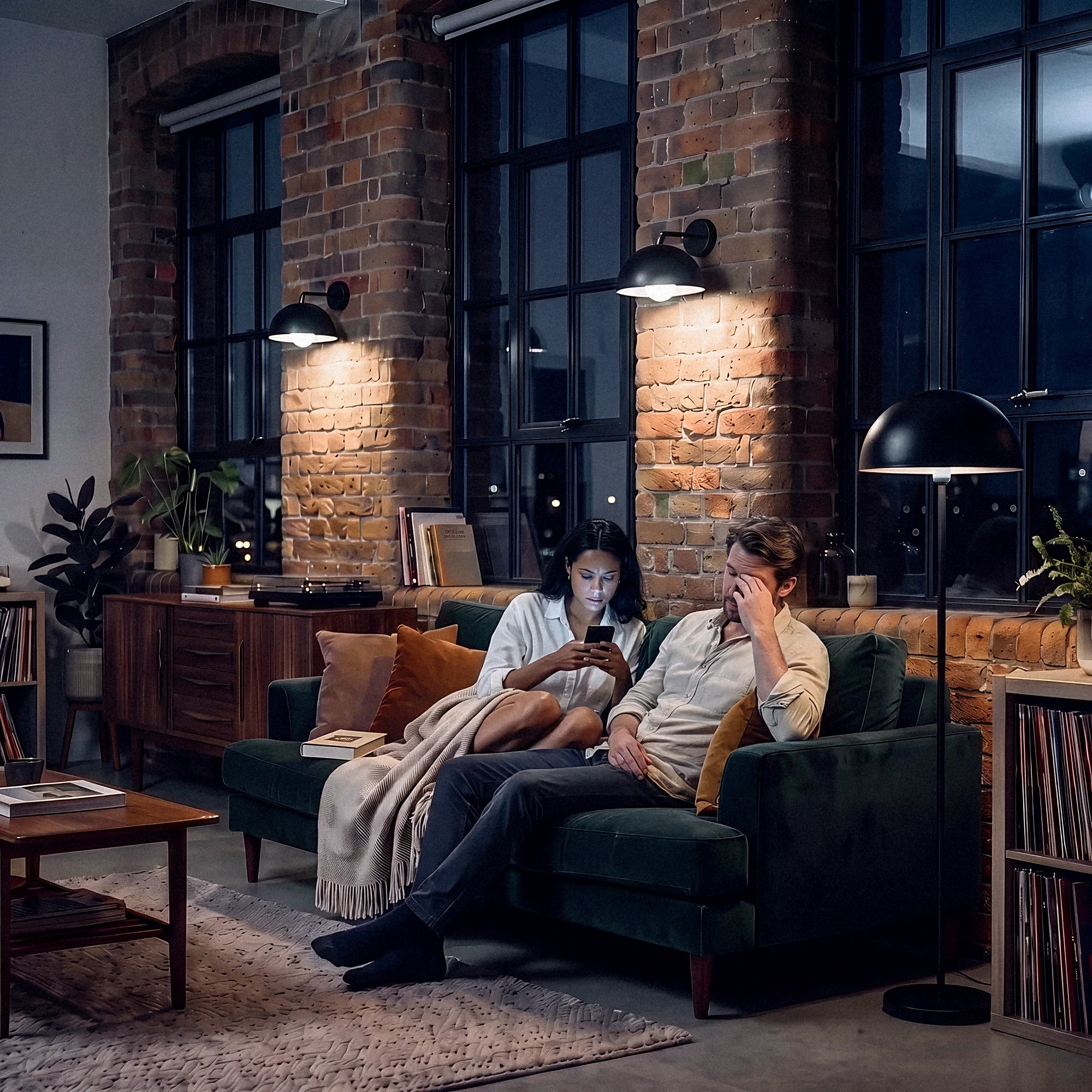
Nearly 1 in 2 homes has evening lighting that would suppress the average person’s melatonin at night by 50% or more.
Is yours one of them?
Dr. Sean W. Cain et al., Scientific Reports (2020)
“I’d tried melatonin, magnesium, meditation and everything else the Dr told me to try. I was still waking at 3am. Now I sleep through the night.”
“I fall asleep much faster compared to the other lights I was using, and am able to stay asleep longer.”
“Started feeling the difference after the first night… a sense of calm and quiet.”
“We’re all sleeping so deeply… I think everyone can use the Better Sleep Bulb, but especially those with insomnia or trouble falling asleep.”
“I bought a 6-pack and installed them in all of my family’s bedrooms. My two children, wife, and I are all sleeping better!”
Light isn't just for seeing — it's the signal that tells your body clock when to be alert, and when it's safe to rest.
For most of human history, the natural shift from daylight to darkness guided us into deep sleep, effortlessly.


Outside 9:00 PM
Inside Noon
Standard white LEDs flicker over 100 times a second, too fast for your eyes to see.
Instead of signaling your body to switch off, they keep you stimulated, suppressing your natural melatonin release at night: delaying and disrupting sleep, and leaving you tired but wired, then exhausted in the morning.
That’s why nothing you’ve tried has worked.
The problem was never you: it was your light.
“People are far more sensitive to evening light than we once assumed. The Better Sleep Bulb was designed to remove blue light and reduce brightness at night, which are some of the most impactful changes you can make for melatonin and sleep.”
Ample by day, minimal in the evening and none at night, so melatonin rises naturally and sleep comes easily.
From bright and energizing when you wake, to a dim firelight glow before bed, one light for day and night.
Restorative wavelengths up to 1,000nm in every mode, linked to energy, recovery, lower inflammation, and skin health.
No invisible flicker keeping you on edge, just a steady, calm light that gives your body permission to unwind.
Simply flick your normal switch off and on within 2–3 seconds to change mode.
No app, remote, or Bluetooth required.
Leave it off for 10+ seconds and it remembers your last mode. Set it to Night mode once, and it stays there until you decide otherwise.
| Better Sleep Bulb | Standard LED | Other Sleep Bulbs | |
|---|---|---|---|
| Circadian coverage | Full day/night | None | Night only |
| Blue-light-free mode | ✓ | ✗ | Varies |
| Near-infrared in every mode | ✓ | ✗ | ✗ |
| Flicker-free | ✓ | ✗ | Varies |
| No app/Bluetooth needed | ✓ | ✓ | Varies |
| Meets expert evening-light guidance | ✓ | ✗ | Varies |
More than half of the energy in sunlight and firelight is invisible infrared light. Standard LEDs don't produce any.
In a 2024 study, adding deep red and near-infrared light to ordinary indoor lighting improved heart-rate variability: a sign your body is calming down, ready for sleep.
Night mode gives your body the signal it’s been missing, so melatonin rises and sleep deepens naturally.
Usually one to three nights, and many people feel it on the first evening.
Your body clock reads Evening and Night modes as night approaching, so melatonin rises, stress hormones fall, and you feel it: a calmer evening, a wave of tiredness, an easier drop into sleep.
Where you’ll feel it first. The effect comes from the light around you. One Better Sleep Bulb in your bedside lamp changes the light in your bedroom before sleep, whether you’re reading in bed or winding down there for a while. Spend that time with the right light on and you’ll feel it. It’s a real difference on its own.
If you don’t feel much at first. The most likely reason is other light working against it. Standard white LEDs in the kitchen, hallway, or living room tell your body clock it’s still daytime, so the more of your evening you spend under them, the weaker the signal your body gets that it’s time to sleep.
The simple fix. Spend your evenings in the rooms lit by the Better Sleep Bulb, and keep standard white lights off wherever possible. The more of your evening that’s lit with the right light, and the less that’s lit by the wrong light, the stronger and faster the effect. That’s why many people start with one lamp and add additional coverage for other rooms over time.
Try it for 30 nights, risk-free. If your sleep hasn’t improved, email us at team@inrhythm.earth within 30 days of delivery.
We refund everything: the full price, the original shipping, and your return postage. Simply send the bulb back and email us a photo of your parcel and the postage receipt to prove the return, and we’ll refund you straight away. Otherwise, we’ll refund you in full as soon as the bulb arrives back with us.
Every bulb also includes a 12-month warranty. Read the full returns and warranty policy →
Don’t want a schedule? You don’t need one. You can set your bedside lamp to Evening or Night mode, and keep it that way. The guide below is for anyone who wants to use more than one mode.
Night (1200K)8 PM, or 2–3 hours before bed.A dim, firelight-inspired red tone with no blue light, for before sleep and if you wake and need light after dark: for safety, nighttime feedings, or as a nightlight.
Evening (2000K)6 PM – 8 PM, or from sunset.A soft, golden sunset tone with 96% of blue light removed: bright enough for cooking, reading, and relaxed evenings, while still allowing your body to wind down naturally.
Day Plus (4000K) and Day (2700K)6 AM – 6 PM, or when the sun is up.Use them interchangeably. Day Plus is bright, cool-white light for energy and alertness; Day is warm white with a softer, more comfortable feel. Both are full-spectrum and render color almost exactly as sunlight does (CRI 98–99), so you see clearly and colors look as they do in daylight.
Two important caveats
1. Darkness. During sleep, your body clock expects no light at all. Night mode is for the hours before bed and any time you need light during the night. When you go to sleep, switch the light off and sleep in total darkness where you can.
2. Daylight. Your body clock needs bright daylight to distinguish day from night. No artificial light comes close to the signal provided by natural light. Get outside in the morning and during the day, whenever you can.
The Better Sleep Bulb is designed to support keeping your indoor hours in rhythm. It is not a replacement for a dark sleeping environment at night, or natural light during the day.
Flick your normal switch off and back on within 2–3 seconds to move to the next mode. The modes run in this order: Day Plus → Day → Evening → Night.
If the switch is left off for more than 10 seconds, the bulb comes back on in your last-used mode. So if you want it to stay in one mode, set it once and it stays there. No Bluetooth, remote, or app required.
Yes. It’s a standard A60 bulb that fits any E26/E27 socket, so you swap it in like any other bulb. (A B22 bayonet version is available in our 1st generation bulb, with more bases to follow.)
Works with: standard on/off wall switches (including two-switch setups, like the top and bottom of the stairs), pull cords, lamps, enclosed fixtures, plug-in or wall timers, and most smart plugs and smart switches set to simple on/off.
Not compatible with: touch-controlled lamps, twist or rotary lamps, or three-way lamp sockets (the US lamps that click through low, medium, and high), because they don’t give the clean on/off signal that mode-cycling needs. Avoid dimmers where possible; if you can’t, keep the dimmer at full brightness.
Yes. It has no UV, no flicker, and no smart-control EMF. Night mode is ideal for nighttime feedings and check-ins without disrupting anyone’s body clock.
This is a pre-sale. Orders placed now are reserved from our next production batch, shipping late October 2026. Once the batch arrives, orders leave our fulfillment facility within 24–48 hours.
Shipping is a flat $5.95, worldwide. USA 3–8 business days; international 7–14 business days.
Customs. We don’t collect import duties or taxes at checkout. Depending on your country, your customs authority may charge import duties or taxes on delivery; these are set by your government. The bulb runs on AC 100–240V, so it works in every country.
Built for the whole day, not just bedtime. The Better Sleep Bulb has four modes in one bulb, so your body gets the right light from morning to night.
Night mode removes blue light completely and keeps the brightness low, so melatonin can rise fully before sleep. Evening mode removes 96% of blue light, so melatonin can start to rise while you’re still up, cooking, reading, or relaxing. Day and Day Plus give you clear, full-spectrum daylight, so your body clock knows it’s daytime.
In every mode, you get deep red and near-infrared, the restorative part of sunlight and firelight that most red and amber bulbs leave out. The whole bulb is flicker-free, with no app or remote needed.
Light you can actually use. Day, Day Plus and Evening are all bright enough for cooking, reading, working, and everyday life, and they show colors as they really are, so you can see what you’re doing.
The problem with single-color bulbs. A red or amber bulb gives you one flat tone, often still too bright for the hours before sleep, when you need dimmer, more relaxing light. Under it, everything in the room takes on that one color, so you can’t tell red from brown or green from gray, which makes cooking, cleaning, and everyday tasks harder. Most people find they can’t live under that light, so the bulb gets switched off and the standard LEDs come back on. And unlike the Better Sleep Bulb, many red and amber bulbs are built on a low-cost driver that flickers, keeping you more stimulated, just like a standard LED.
Two major upgrades.
A new Day Plus mode (4000K, approximately 430 lumens): brighter, cooler light that is more stimulating and energizing for daytime hours.
A brighter Evening mode (approximately 160 lumens, 25% brighter than before) with high color rendering (CRI 94), making it perfect for cooking, reading, and relaxed evenings, while still removing 96% of blue light so melatonin can rise naturally as you wind down.
Alongside the Day and Night modes, that gives you four modes of healthy light from morning to night in a single bulb, with deep red and near-infrared in every mode and a flicker-free, low-EMF driver. The 1st generation is still available in a B22 bayonet version.
The measure that matters. Scientists measure how strongly a light tells your body clock “it’s daytime” in melanopic lux. The higher the number, the louder the daytime message.
The expert limit. The international guidance for healthy indoor light (Brown et al., PLOS Biology, 2022) is no more than 10 melanopic lux in the three hours before bed, and no more than 1 while you sleep.
Most homes miss it. The same paper, citing Dr. Sean W. Cain’s study, reports that evening light at home is over that limit about half the time, and that the homes over it are usually the ones lit by white, blue-rich LEDs. That’s the light telling your body it’s still daytime.
The Better Sleep Bulb. Measured at 1 m (about 3 ft), Evening mode is about 6 melanopic lux and Night mode about 0.3: both inside the guidance, so your evenings stay lit and your body clock still gets the message that night has come.
In 2017, Jeffrey Hall, Michael Rosbash, and Michael Young won the Nobel Prize in Physiology or Medicine for discovering the molecular clock that runs your circadian rhythm: the internal 24-hour cycle that controls when you feel alert and when melatonin rises for sleep.
Light is the main signal that keeps that clock in time. The Better Sleep Bulb’s four modes are designed around this science, giving your body the right light signal at each time of day.
Home lighting and melatonin. Dr. Sean W. Cain (our scientific advisor) et al. “Evening home lighting adversely impacts the circadian system and sleep.” Scientific Reports, 2020. Read the study →
Healthy indoor light guidance. Timothy M. Brown et al. “Recommendations for daytime, evening, and nighttime indoor light exposure to best support physiology, sleep, and wakefulness in healthy adults.” PLOS Biology, 2022. Read the study →
Near-infrared and heart-rate variability. Charlotte M. Roddick et al. “Effects of near-infrared radiation in ambient lighting on cognitive performance, emotion, and heart rate variability.” Journal of Environmental Psychology, 2024. Read the study →
The body clock. The Nobel Assembly at Karolinska Institutet. “The 2017 Nobel Prize in Physiology or Medicine.” Press release, 2017. Read on NobelPrize.org →
The Better Sleep Bulb is a wellness product, not a medical device. Statements on this site have not been evaluated by the FDA or any other regulator, and our products are not intended to diagnose, treat, cure, or prevent any disease. Nothing on this site is medical advice. If you have a sleep or medical condition, or a condition affected by light, please speak to a qualified healthcare professional.